About NomadTiming
NomadTiming answers one question better than anyone: where should you base yourself, in what season, given your budget, your working hours and what you want from a place, and why.
What NomadTiming is
Most tools for digital nomads are noisy, dated, paywalled, or miss the one dimension that matters most for a multi-month stay: when in the year a place actually works. NomadTiming is built around that. You set a monthly budget, how long you're staying, where your team sits and up to three priorities, and a living globe ranks real nomad bases by how well they fit, right now.
The catalogue is 46 hand-picked bases across Southeast Asia, Latin America, Southern and Eastern Europe, the Caucasus, Africa and the Middle East, from established hubs like Lisbon, Chiang Mai and Mexico City to rising spots like Tbilisi, Da Nang and Siargao. Quality over quantity: every base carries sourced data on cost, internet, coworking, visa, timezone, safety, housing and its best months.
How the fit score works
Every base gets a 0 to 100 score for the exact setup you configure. The score is a weighted average of up to eleven factors, and it's never shown alone. Every base breaks it down under "Why this score", so a number always comes with its reasons.
Two things run before scoring. Three hard filters can exclude a base outright: you can't afford it even frugally, you asked for cooler or warmer and its measured temperature that month is the other side of 24 °C, or you chose a priority its own data shows it cannot deliver. A visa never excludes anyone, because entitlement depends on your passport; it is flagged per destination instead. Then the priorities you pick count double; everything else counts once.
| Factor | What it measures |
|---|---|
| Cost | Your monthly budget against the base's real cost of living, per person, adjusted for the length of your stay. |
| Internet | Median download speed and reliability, the deal-breaker for remote work. |
| Community | How established the remote-work scene is, plus the coworking density and whether spaces are call-friendly. |
| Beach | Whether this is genuinely a coast base: a beach, and whether the surf is part of why people go. |
| Mountains | Whether the hills and trails are the draw. Generic greenery supports this but is never enough on its own. |
| City & food | City life, food and nightlife, the everyday texture of a big base. |
| Safety | A coarse safety and stability rating from recognised sources. |
| Healthcare | A coarse rating of medical care and how reachable private treatment is. Counts half unless you pick it as a priority. |
| Timezone | How much the base's working hours overlap with your team's, only scored when you set a timezone anchor. |
| Climate | How well your chosen months hit the base's best season, with a penalty for wet or rainy months. |
| Temperature | Whether the month you would land in is as warm or as cool as you asked for, judged on measured climate normals rather than how a season is described. Off by default. |
When a base is missing a datapoint, that factor is dropped and the rest are re-weighted, a base is never penalised for a gap, and the panel says "Score based on N of M signals" so you know. The factor curves are built to spread results, so the ranking is informative rather than a wall of identical numbers.
About the data & confidence
NomadTiming v1 ships static, hand-curated data, no live APIs. Because of that, most measured values are labelled estimated (from sources like Numbeo and the Speedtest Global Index) rather than verified, and every datapoint shows its source, date and confidence. Nothing is invented: where a value can't be credibly sourced it reads "No data" and drops out of the score.
Every figure in the essentials is a curated estimate, so we don't label each one as such. What is worth flagging is when a number describes the whole country rather than the city you are reading about, and those rows say so. Internet is the clearest case: where the Speedtest Global Index publishes a monthly fixed-broadband median for the city, that is what we show, and otherwise the national median, and each row says which. Neither is a reading from a particular flat or coworking space. Real connections vary building by building and change over time, so treat it as a guide to what the place supports, not a promise about your desk.
Visa figures assume a typical EU/US/UK passport and describe the simplest tourist entry, always verify against the official source before you rely on them.
Who is behind it
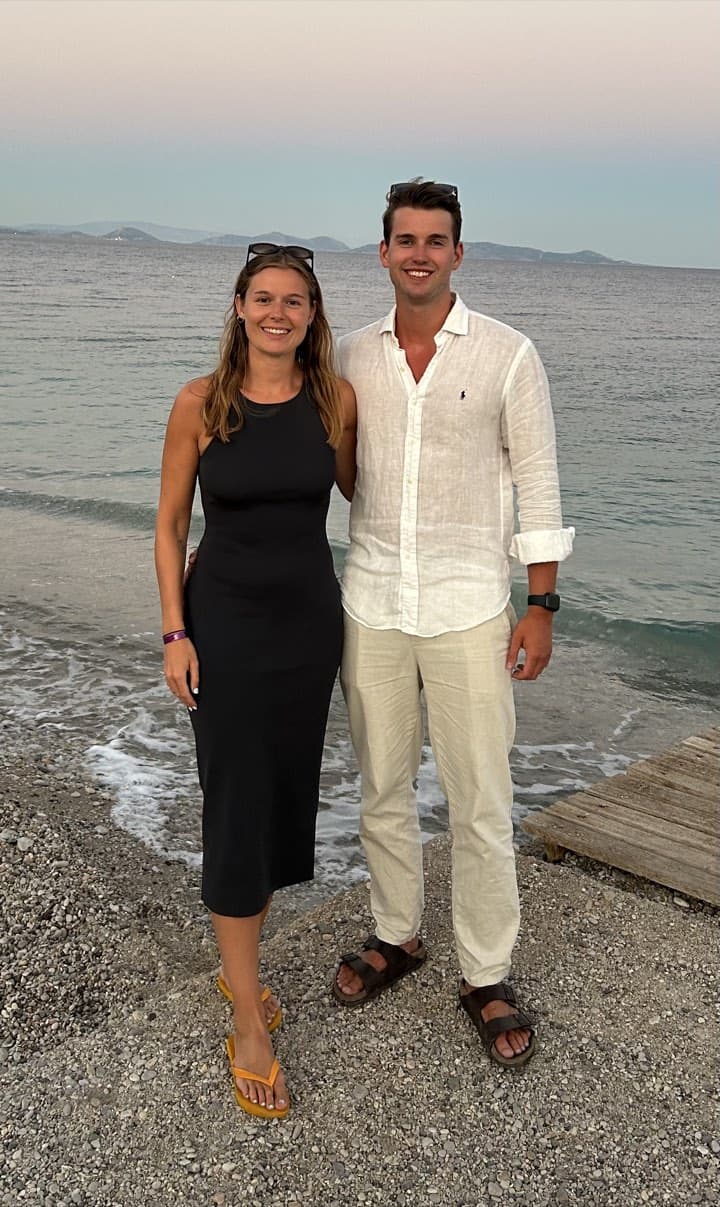
We are Rasmus and Victoria, and we have been travelling together almost as long as we have been together. The longest trip began as a bet with ourselves: to write the master's thesis from Siargao in the Philippines rather than from a desk in Denmark. Staying somewhere for months instead of a week teaches you how much the calendar decides. You live through the turn from dry season to wet, watch the tourists arrive and disappear again, and see the prices follow.
NomadTiming came out of the same question, asked about staying rather than visiting: where do we base ourselves next, and when? It is the tool we went looking for and could not find, so we made it ourselves, and we still use it to plan our own next few months. You are welcome to use it for yours.
If you want to support it
NomadTiming is free and carries no advertising. Nothing here is for sale, including where a base lands in the ranking, and that will not change. The cup in the top bar is for anyone who wants to say thanks.
We are working our way towards doing this from the road for good, so a small amount helps as much as a large one. If you would rather not, that is fine too.
Buy us a coffeeSources
Everything the catalogue is built on, with the terms each one is published under. Every figure on a destination page also links to its own source next to the number.
- Core Nomadic field notesCore Nomadic, own content
- National meteorological services / WMO climate normalsPublic meteorological data, attribution required
- NomadTiming editorial (coworking survey)NomadTiming editorial, own content
- NomadTiming editorial (nomad community)NomadTiming editorial, own content
- Numbeo (cost of living)Numbeo terms, attribution required, redistribution restricted
- Numbeo Health Care IndexNumbeo terms, attribution required
- Numbeo rent index / local rental listingsNumbeo / listings, attribution required
- Numbeo Safety Index / public travel advisoriesNumbeo / government advisories, attribution required
- Official immigration guidancePublic government information
- Speedtest Global Index (Ookla)Ookla country index, editorial reference only
Photos
Destination photos come from the Unsplash CDN, whose licence asks for nothing, and from Wikimedia Commons, where each of these is CC BY or CC BY-SA and the photographer must be named. Images are shown unmodified, at Wikimedia's own rendering.
- Antigua GuatemalaJuan FranciscoCC BY-SA 2.0
- Banskowww.bdmundo.comCC BY-SA 2.0
- BelgradeZlatanJovanovicCC BY 3.0
- Da NangSomerset999CC BY-SA 4.0
- Florianópolisoscar favaCC BY 3.0
- Koh PhanganManfred Werner (User:Tsui)CC BY-SA 3.0
- Las Palmas de Gran CanariaBengt Nyman from Vaxholm, SwedenCC BY 2.0
- MálagaKibanCC BY-SA 3.0
- NairobiDaniel CaseCC BY-SA 4.0
- Playa del CarmenSSCreaderCC BY 4.0
- SplitTatyana PeshkovaCC BY-SA 4.0
- Taghazout瑞丽江的河水CC BY-SA 4.0
- TallinnJorge FranganilloCC BY 2.0
- TbilisiAlexey KomarovCC BY-SA 4.0
- UbudVyacheslav ArgenbergCC BY 4.0
- ValenciaDiego DelsoCC BY-SA 4.0
Disclaimer
NomadTiming is an orientation tool, not advice. Every figure is a curated estimate meant to narrow 46 places down to a shortlist, not to be relied on for a decision that costs money. Costs, internet speeds, safety and healthcare ratings change and vary by neighbourhood, building and season. Visa figures assume a typical EU/US/UK passport, differ by nationality, and change often: confirm the current rules for your own passport with an official source before you book anything. Nothing here is legal, immigration, medical or financial advice, and we take no responsibility for decisions made on it.
Related site
Core Nomadic is run by the same people as NomadTiming. It publishes free, first-hand guides to places we have actually lived in, and these are in this catalogue: Siargao, Chiang Mai. Their destination pages link to it. That link moves nothing in the ranking, and nobody, ourselves included, can buy a place in it.